Your University Cannot Hire Enough Winter Grounds Staff. What Are the Real Options?

Kishore Krishnamoorthy
Most campus grounds managers are not short of a plan. They are short of people to execute it. The winter plan assumes a crew that no longer turns up, and every option from there is a compromise.
The arithmetic is unforgiving. A campus has miles of walkway, not acres of lot, and walkway is the part that carries the liability. It also has to be clear before the first class, which means the work happens between roughly three and seven in the morning, which is the shift nobody wants. Seasonal grounds roles compete with warehouse and delivery work that pays similarly and is indoors.
Here is what campuses actually do, and what each choice costs you somewhere else.
Reprioritize the route and accept the consequence
The most common response, and the most honest one, is to formally shrink what gets cleared first. Accessible routes, main entrances, residence egress and the medical center come first. Peripheral paths wait.
This works and it is defensible, provided it is written down before the season rather than decided at four in the morning. The cost is that a published priority map is also a published admission of what is not being cleared, and someone will eventually fall on a path you deprioritized. Document the reasoning, review it annually, and make sure disability services agree with the order.
Student labor
Cheap, available and genuinely willing. Also unavailable during reading week, exam period and the entire winter break, which between them cover a large share of the season.
Students are a useful supplement for daytime touch-ups and a poor foundation for a pre-dawn route. If you use them, use them for the second pass, not the first.
A contractor
Moves the hiring problem off your desk. During a regional storm it does not remove it, it queues it. You are one of many sites and your position in that queue is determined by your contract, not your need.
Worth asking any contractor two questions. What is your response time measured from, and how do you show me what was actually cleared? The second question separates serious operators from invoicing operators very quickly.
Pre-treatment
The highest return per dollar on this list, and consistently under-used on campuses because it requires someone to go out before the weather rather than after it.
Anti-icing before a storm stops ice bonding to the surface, which makes everything that follows easier and sometimes unnecessary. It does not move accumulation, so it is a complement rather than an alternative. But a campus that pre-treats well needs fewer people on the clearing pass, which is the whole problem you are trying to solve.
Automation
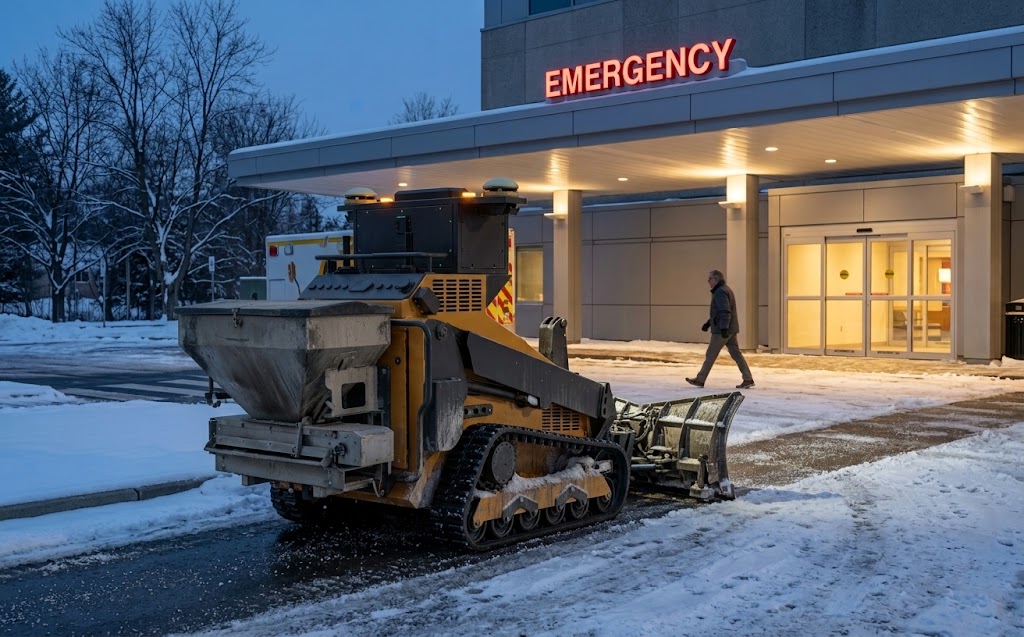
Autonomous clearing is a genuine option for campus walkways specifically, and a weaker one for open lots. That distinction matters and most coverage of the category ignores it.
Walkways suit automation because the route is fixed, the geometry repeats, and the work has to be done many times through a storm rather than once. That is exactly the shape of work a machine does well and a tired person does inconsistently at four in the morning.
Some things to establish with any vendor, ours included:
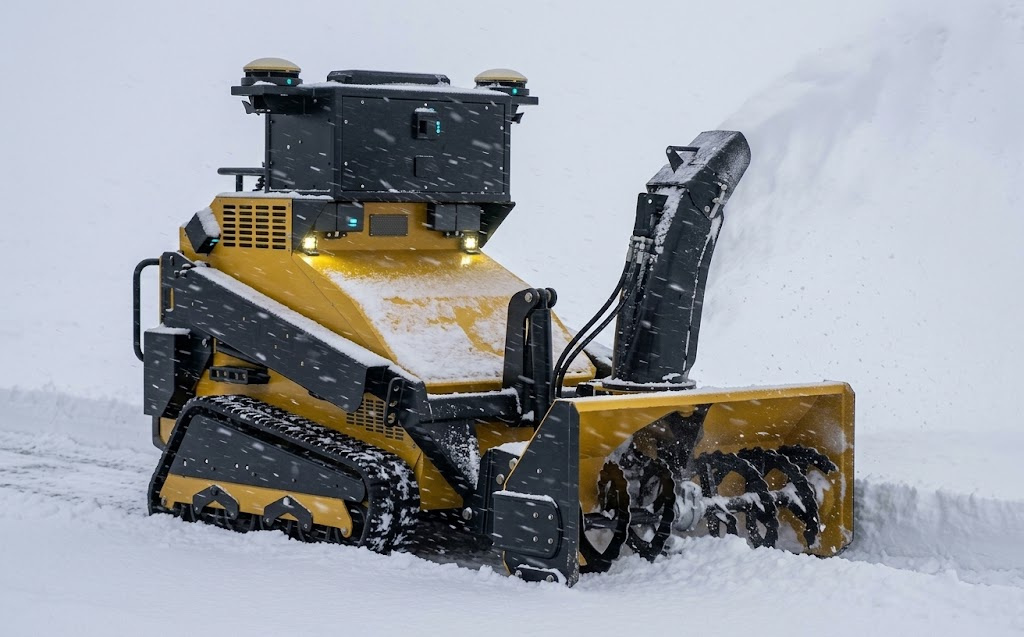
Is it sized for a walkway? A machine built for open lots will be slow and awkward on a five foot path. Our attachment width is optimized for sidewalks and small spaces rather than open ground, and the plow blade adjusts for close work at curbs and building edges.
How long does it actually run? Ask for runtime, not availability percentages. Ours runs more than six hours on a full charge covering clearing and de-icing together, two batteries come with every robot, and a swap takes a few minutes and restores a full charge. That is roughly twelve hours of running in a day on the standard configuration. If a site needs longer, additional batteries are a monthly line rather than a refusal.
What happens in real cold? Lithium cells stop accepting charge somewhere below zero. Our battery packs are self-heating, which is what allows cold weather operation. Be skeptical of any temperature rating a vendor cannot evidence, including from us.
Who supervises it? On our platform a Snowbotix supervisor watches every run remotely and can stop it. Nobody from your grounds team is on site, which is the point, but the machine is not making decisions unattended.
What do you get for the record? Every run produces GPS traced coverage against the boundary you contracted, with timing and conditions, a plain language summary, and before and after images. For a campus facing a slip claim eighteen months later, a coverage trace from that night is a materially better position than a crew member's recollection.
What still needs hands? De-icer refills and emptying the sweeper hopper are manual, and the system notifies you. Attachments change at the turn of the season. The machine does not cross public roads, so a campus split by a public carriageway needs two deployments or a person to move it.
What we would actually suggest
Start with pre-treatment, because it is cheap and it reduces everything downstream. Write and publish the priority map, because you need it regardless. Then be honest about whether your remaining gap is a shift you could fill in a better labor market, or a shift that is simply not going to be filled.
If it is the second, automation is worth costing on the walkway network specifically, not the whole campus. The lots are a different problem with a different answer.
A site assessment maps your walkway network, priority zones, current cost structure and the service level each route needs, then tells you whether this fits. If your gap is better solved by pre-treatment and a contractor, that is what it will say.