

A snow clearing robot is easy to picture and hard to scope. The machine is the visible part. What decides whether it works on your site is the route it is given: which surfaces, in which order, at what trigger, and what happens when the battery runs low at three in the morning. This is how that route is built, and where the method stops helping.
A clearing robot is a route, not just a machine
Buyers tend to evaluate the hardware and inherit the route by accident. That is the wrong way round. Two identical units on two identical car parks produce different results if one opens the main entrance first and the other starts at the far corner. The hardware sets the ceiling. The route decides what you get on the morning after a storm. On our platform the clearing sequences are automated and geofenced across mapped routes, and they are designed to run before opening hours rather than during them. That choice is a route decision, not a hardware one, and it is the single thing most worth arguing about during scoping.
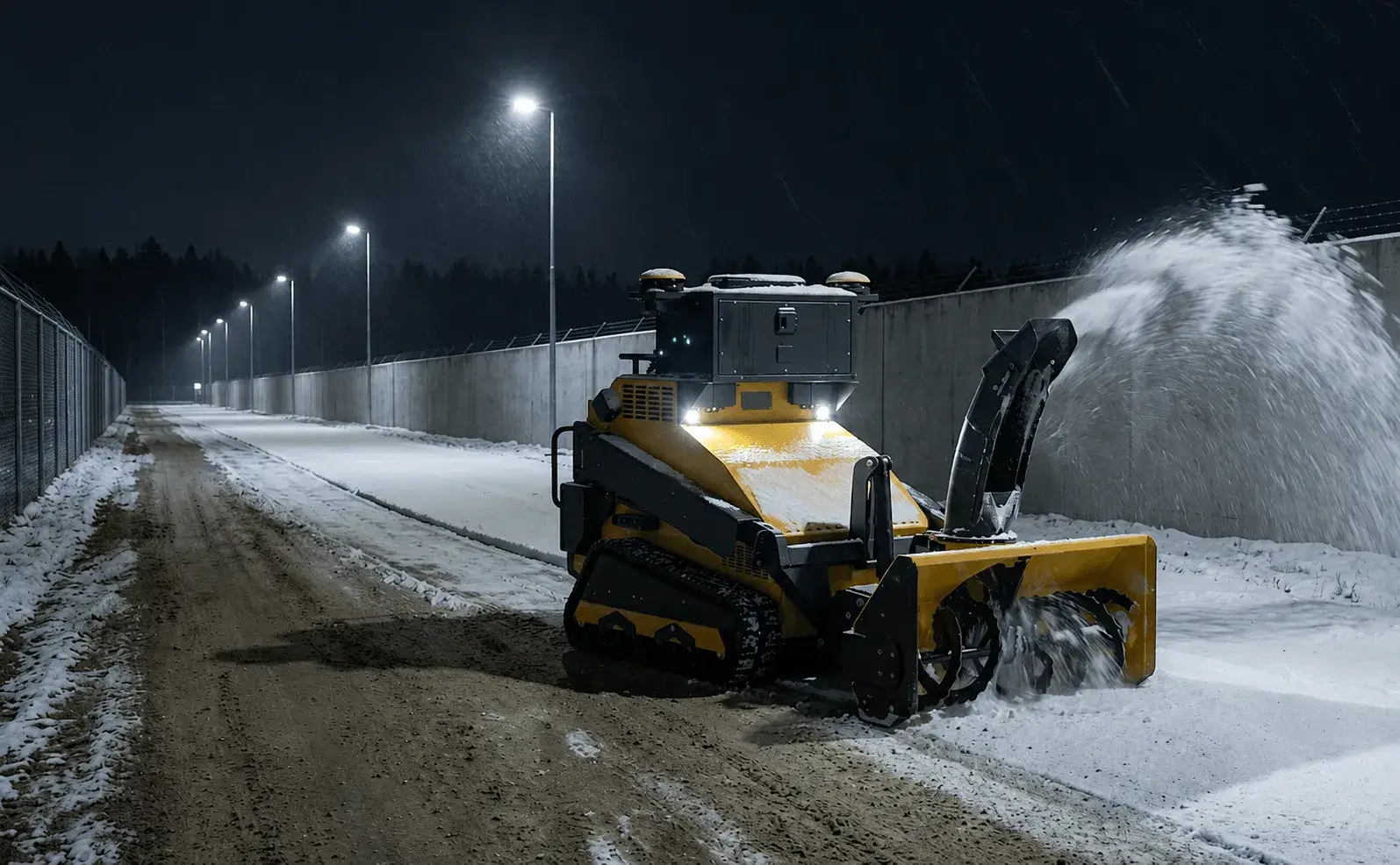
Mapping the site is the first week of work
Nothing autonomous starts until the surfaces are drawn. Every path, apron, bay and walkway that is in scope gets traced to its paved edge, and everything out of scope gets drawn too, because the boundary is what the machine is held to. Getting this wrong is expensive in a specific way: a surface left off the map is a surface nobody clears and nobody notices until someone complains. Ask any vendor, including us, to show you the drawn boundary before you sign, and read it against your own site plan rather than against their description of it.
Zones decide the order, and the order decides the outcome
Once the surfaces are drawn they get grouped and ranked. A hospital does not want its loading dock cleared at the same standard as its ambulance bay, and a university does not want the library steps treated like a service road. Zoning is how that preference becomes a machine instruction. In practice the useful question is not how fast the unit goes, it is which zone is finished by what time. That is the number to write into a scope, because it is the one your staff and your tenants will judge you on. Every route and zone is logged with time and coverage, so the order you asked for is checkable afterwards rather than a matter of trust.
The blade configuration is chosen from the geometry
The adjustable V-plow carries four configurations: V, scoop, angled and full-width. These are selected in real time from the route geometry rather than fitted in advance for the night. That matters more than it sounds. A V configuration opens a narrow path a full-width blade cannot enter, which is why a narrow sidewalk is not automatically a disqualifier, and a scoop carries material rather than smearing it across an entrance. If you are being told your paths are too narrow on the basis of a single blade width, that answer is incomplete. Ask which configuration is being assumed for which stretch of the route.
Why the de-icer goes down before the broom comes through
The sequence we run applies de-icer first to the places that matter most, walkways and entrances, and brings a sweeper broom through afterwards. The reason is physical rather than commercial. A broom that runs first and a treatment that arrives later leaves a window in which a thin film can bond. Running the treatment ahead of the sweep takes the surface to bare pavement without compacting a layer that will refreeze. Two de-icing attachments exist for this, a rear-mounted granular spreader and a rear-mounted liquid brine sprayer, and which one a route uses is again a scoping decision rather than a product one.
Battery windows set the shape of the night
A route has to fit inside the energy available, and this is where plans tend to fail quietly. Our units run more than six hours on a full charge covering clearing and de-icing together, two batteries come with every robot, and a swap takes a few minutes and restores a full charge. The battery packs are self-heating and the heated docking station pre-conditions the pack through sustained cold, which is what keeps a cold start from eating the first hour. Do the arithmetic for your own site before you accept a route: total surface, the order you want it in, and whether the whole sequence closes inside the window you have between the snow stopping and your doors opening.
The sites where a planned route does not help
Four conditions defeat the method rather than the machine, and they are worth saying plainly. Large open lots where raw speed is the only thing that matters are better served by a truck, and a good route does not change that. Deep drifting against buildings and walls is a job for equipment that can move volume, not for a unit working a sequence. A site split by a public road cannot be run as one route at all, because the machine does not cross public roads, so you need two deployments or a person to move it. And a site with no connectivity cannot be supervised remotely, which removes the part of the system that makes an unattended run acceptable in the first place.
Check our claims rather than taking them
We publish operation down to minus 40F. You should treat that, and every other number on this page, as a claim to be tested rather than a specification to be trusted. Ask for coverage records from a comparable site in a comparable month, and ask what the unit did on the night it failed, because every fleet has those nights. We produce GPS traced coverage against the contracted boundary, with timing and conditions, a plain language summary and before and after images, so the question is answerable from records rather than from memory.
What to do with this if you are scoping a site
Start with the drawn boundary and the zone order, not the datasheet. Write the finish time per zone into the scope. Establish who refills the de-icer and empties the sweeper hopper, because both are manual and the system notifies rather than solves. Confirm the connectivity position and the public road question early, since those two rule sites out rather than adjusting them. The attachment range and the specifications are set out on the platform page, and the way clearing, de-icing and sweeping are sequenced across a site is on the solutions page. Both are worth reading before a first conversation rather than after it.