

A robot snow plow and a plow truck are not competing for the same work, and most comparisons go wrong by assuming they are. One moves a large volume of snow quickly across open ground. The other clears a defined area to a defined standard, repeatedly, without anyone being there.
If you are weighing one against the other, the question is not which is better. It is which part of your site is actually failing.
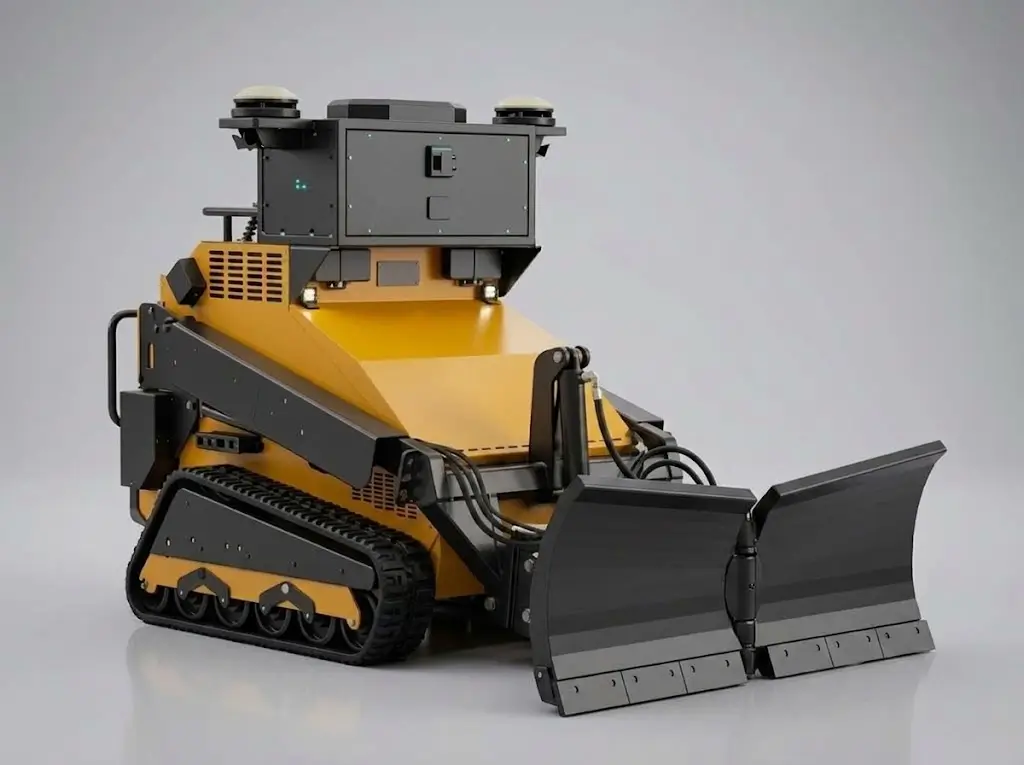
What autonomous plowing does differently
A plow truck clears by volume and by judgement. The operator reads the surface, picks a line, and decides when a pass is good enough. That judgement is valuable and it is also the variable that disappears at four in the morning on the third night of a storm.
An autonomous plow clears by geometry. The site boundary is mapped once, the route is computed from that geometry, and the machine runs it the same way every time. On our platform the positioning is RTK GPS accurate to within an inch, which is what allows a blade to work tight to a curb, a bollard or a building edge without a person judging the gap.
The blade itself matters more than people expect. Ours is a four-configuration adjustable V-plow: V, scoop, angled and full-width, selected in real time from the route geometry rather than set once at the start of a shift. A truck operator changes blade angle when it is worth climbing out to do it. A machine changes it at every corner.
Trigger depth is where most of the argument actually sits
Almost every snow contract specifies a trigger depth. Two inches is typical. Below that, nobody is dispatched, because dispatching a crew and a truck for half an inch is not economic.
Your ambulance bay, your accessible entrances and your main approach do not have a two inch tolerance. They have a zero tolerance. So there is a gap between the standard the contract buys and the standard the risk register assumes, and somebody absorbs that gap informally, usually the facilities team, usually at four in the morning.
This is the single clearest case for automation, and it has nothing to do with speed. A machine that is already on site has no dispatch cost, so the economics that create the trigger depth do not apply to it. It can go out at half an inch, or on a forecast of freezing precipitation, and it can go out again two hours later.
Where a plow truck still wins
Be honest about this or the rest is not credible.
Open lot volume. A truck pushes more snow per hour across an empty acre. If your problem is one fast push after the storm ends and nothing else, a truck is the right tool and a robot is an expensive way to do it slowly.
Deep drifting against structures. A four foot drift packed against a wall is a loader job. It is a loader job for a truck too, but nobody should imply a robot solves it.
Anything across a public road. Our machines do not cross public carriageways. A site split by one needs two deployments or a person to move the machine.
Sites with no connectivity. Remote supervision needs a network. No network, no deployment.
What the robot gives you that a truck cannot
Passes nobody would dispatch for. The second clear, the third clear, the de-icing pass, the pre-dawn pass. These are where surface condition is actually won and they are the first thing cut when labor is short.
A record that holds up. Every run produces a GPS traced coverage map against the contracted boundary, with timing, conditions, a plain language summary and before and after images. When a claim arrives a year later, that is a different conversation from an invoice and a recollection.
No shift to fill. The pre-dawn winter shift is the hardest one in the business to hire for and to keep filled. It competes with warehouse and delivery work that pays similarly and is indoors.
No exhaust at the point of use. Fully electric, so parking structures, loading docks and covered approaches do not need ventilation planning.
Supervision, because autonomous should not mean unattended
A plow blade is a serious piece of equipment and it should not be running on a site unwatched. On our platform a Snowbotix supervisor monitors every run remotely and can stop the machine, with override taking effect in under three seconds. Nobody from your team is standing in the cold, which is the point, but the machine is not left to its own judgement either.
Ask any vendor in this category how supervision works and who is responsible when something goes wrong. If the answer is vague, that is your answer.
What it costs, and in what shape
A plow truck is a capital purchase, a depreciating asset, an insurance line and a person. It also sits idle for eight months.
We do not sell machines. The platform is a monthly subscription covering the hardware, remote supervision, the software and maintenance. There is no capital approval to get through and no asset on your books. Whether that is cheaper than a truck depends entirely on your site, your labor cost and how many passes you actually need, which is why the honest version of this answer comes from measuring a specific site rather than from an article.
The same base unit also takes a two-stage snow blower, granular and liquid de-icing, sweepers, mowers and a brush cutter, nine tool-free attachments in total, so it is working through the other eight months rather than parked. That matters to the cost case only if you hold the grounds and sweeping scope for the same site.
How to decide
Ask yourself which failure is costing you. If it is volume on an open lot after the storm, keep the truck. If it is the passes you cannot dispatch for, the shift you cannot fill, or the proof you cannot produce, an autonomous plow addresses exactly those and a truck does not.
Most sites end up with both, used for the work each is good at.
A site assessment maps your surfaces, priority zones and the service level each route needs, then tells you whether this fits. If the answer is that a better contract and some pre-treatment would solve more of the problem for less, that is what it will say. The blade configurations and the rest of the attachment set are on the platform page.