

Most of what is written about snow removal robots is written by people who have never had to clear a site at four in the morning. The category is real and it works, but it works on some surfaces and not others, and the difference matters more than any spec sheet.
This is a plain account of what these machines do, where they earn their place, and where you would be better off with a truck and a crew.
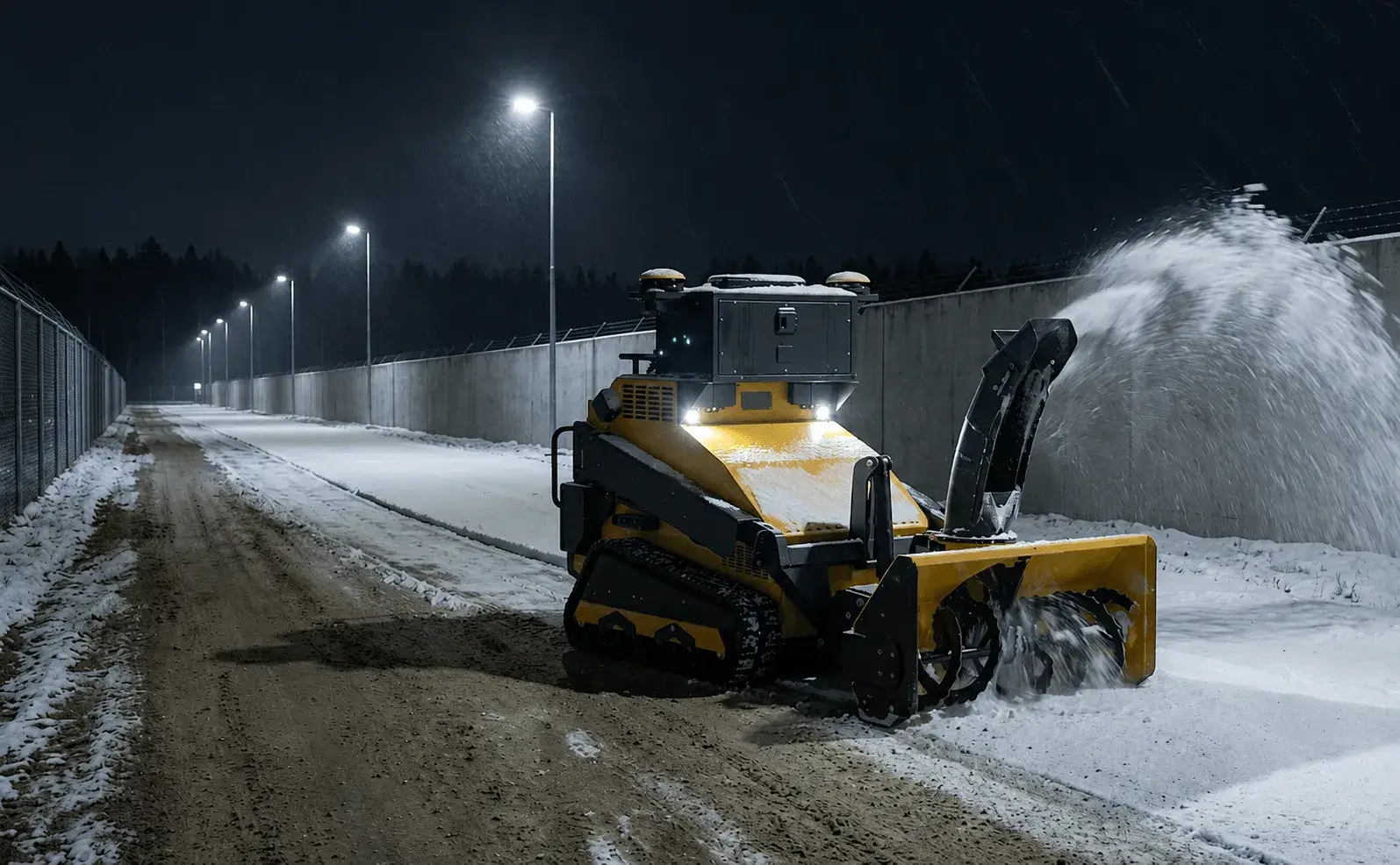
What a snow removal robot actually is
An autonomous snow removal robot is a self-driving machine that clears a pre-mapped area on a schedule or on a weather trigger, without anybody standing next to it. It navigates by satellite positioning rather than by following a buried wire or a painted line, which is why it can work an irregular site rather than a fixed loop.
The useful ones are not snow blowers with sensors bolted on. They are built around three things: a drive system that keeps traction on ice, positioning accurate enough to clear to a curb without hitting it, and a way for a human to stop the machine immediately. On our platform the positioning is RTK GPS accurate to within an inch, and human override takes effect in under three seconds.
The second thing to understand is that clearing snow is only part of the job. A machine that plows but cannot de-ice leaves you dispatching a person anyway, which removes most of the point.
Where they work well
Walkways, paths and building approaches. This is the strongest case and it is not close. Walkway clearing is repetitive, has to happen several times through a storm, and carries most of the slip liability on a site. It is also the work crews do worst at four in the morning, because it is cold, slow and unglamorous.
Sites where the route is the same every time. A campus, a hospital perimeter, a distribution yard, an apron. Once the boundary is mapped, the machine clears the same geometry to the same standard on the hundredth pass as the first.
Sites that need a record. If you have ever had a slip and fall claim arrive fourteen months after the fall, you know the problem is rarely the clearing. It is proving the clearing happened. Every autonomous run produces a GPS traced coverage map against the boundary you contracted, with timing, conditions and before and after images. That is a materially stronger position than a crew member's recollection.
Enclosed and emissions-sensitive spaces. An electric machine produces no exhaust at the point of use, so parking structures, loading docks and covered walkways are workable without ventilation planning.
Where they do not work, and nobody should pretend otherwise
Large open lots, if speed is the only measure. A plow truck moves more snow per hour across an empty acre than any robot on the market. Where the robot wins on a lot is in the passes nobody does: the repeat clears through a long storm, the de-icing pass, the four in the morning pass. If your lot needs one fast push and nothing else, a truck is the right answer.
Anywhere the machine has to cross a public road. It does not. A site split by a public carriageway needs either two deployments or a person to move the machine between them. Build that into the plan rather than discovering it in December.
Deep drifting against structures. Machines handle accumulation well and handle a four foot drift packed against a wall badly, as does most equipment. That remains a job for a loader.
Sites with no network coverage. Remote supervision needs connectivity. If the site has none, that is a conversation before anything else.
The things to ask any vendor, including us
Ask for runtime in hours, not an availability percentage. Availability figures are marketing. Runtime is operations. Ours runs more than six hours on a full charge covering clearing and de-icing together, two batteries come with every machine, and a swap takes a few minutes, so roughly twelve hours of running in a day on the standard configuration.
Ask what happens in genuine cold. Lithium cells stop accepting charge below freezing, which is a physics problem rather than an engineering preference. Ask how the vendor solves it. Our battery packs are self-heating and the heated docking station pre-conditions them through sustained cold, which is what makes operation down to minus 40F possible. Be skeptical of any temperature rating a vendor cannot evidence, ours included.
Ask who is supervising. Autonomous should not mean unattended. On our platform a Snowbotix supervisor watches every run remotely and can stop the machine. Nobody from your team stands in the cold, which is the point, but the machine is not making decisions on its own.
Ask what still needs hands. There is always something. On ours it is de-icer refills and emptying the sweeper hopper, both of which the system notifies you about, and changing attachments at the turn of the season.
Ask whether you are buying a machine or a service. This changes the economics completely. We do not sell machines. The platform is a monthly subscription that includes the hardware, the supervision, the software and the maintenance, so there is no capital approval and no asset sitting idle for eight months.
Year round is the part that changes the maths
A machine that only works in winter is idle for most of the year, and that idleness is in the price whether it is a purchase or a subscription.
The same base unit on our platform takes nine tool-free attachments: an adjustable V-plow, a two-stage snow blower, granular and liquid de-icing, two sweeper configurations, two mowers and a rotary brush cutter. Snow in winter, sweeping and mowing the rest of the year. Whether that matters depends entirely on whether you also hold the grounds and sweeping scope for the same site. If you do not, say so early and the cost case looks different.
How to decide
Work out which part of your site is actually failing. If it is the lot and you need one fast push, buy a better truck. If it is the walkway network, the pre-dawn shift, the repeat passes through a long storm, or the proof you cannot currently produce, then automation is worth costing properly.
A site assessment maps your surfaces, priority zones, current cost structure and the service level each route needs, then tells you whether this fits. If the honest answer is that pre-treatment and a better contract would solve more of your problem for less money, that is what it will say.
The full attachment set and the platform specifications are on the platform page.